
1
Frame the claim
Document intended outcomes, geography, cohorts and the evidential basis at approval.

Central government · Local authorities · UK cities
DDPP works with Government statistics to provide decision support on policies grounded in population-level data. When early evidence was sample-based or speculative, we stress-test implementations and measure whether claimed outcomes have manifested — months to years after policies bed in.
Policy domains are where interventions live. Health and equity are how every commission is judged — using population data and community evidence across UK cities and their regions.
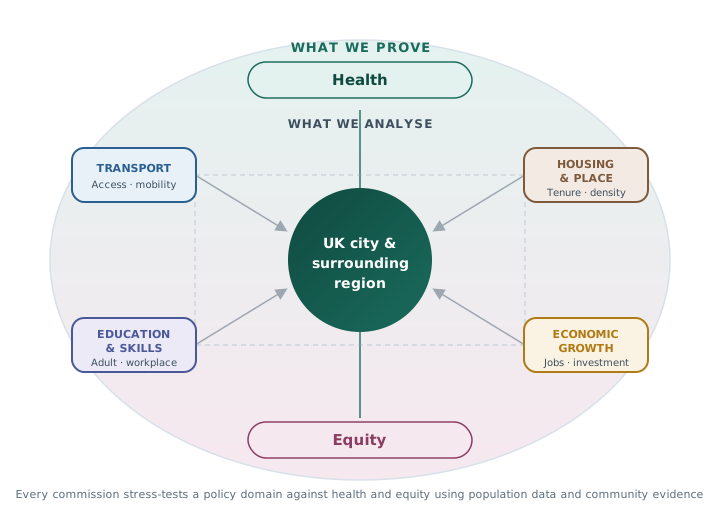
What we analyse
Mobility, access and street schemes — stress-tested at corridor and city-region scale.
Affordability, tenure and regeneration — the glue linking neighbourhoods to regional markets.
Jobs and investment claims — with employment and income read through the equity lens.
Adult and workplace learning — uptake and progression after programmes have bedded in.
What we prove
Cross-cutting lenses on every domain — who benefited, who bore costs, and what moved in official data.
Many sustainable policies launch on pilots, modelling or limited surveys. DDPP is built for the later stage — when ministers, directors and elected members need to know whether promises held up at scale.
Document intended outcomes, geography, cohorts and the evidential basis at approval.
Identify population-level indicators and lag structures that can confirm or refute the claim.
Run forums and polling in affected communities to capture lived experience statistics miss.
Deliver decision-ready synthesis: continue, adapt, scale or stop — with health and equity breakdowns.
We support teams that need independent, rigorous analysis — not advocacy.
Tell us the policy domain, place and outcomes that were promised. We will outline how official statistics and community evidence can be combined for a proportionate proof exercise.